From Marine Explorer to Reef Mapper: Samudra’s Training Pathway to Dive with Purpose
- Samudra Conservation

- Jun 29
- 6 min read
Updated: Jul 1
The Andaman Islands are home to some of the most remarkable marine ecosystems in the Indian Ocean from coral reefs, mangrove forests, seagrass meadows to rocky shores and pristine sandy beaches. These picturesque and beautiful locations have put the Andamans on the map as a popular tourist destination.
However, when viewed from a marine science and resource lens, much of the archipelago remains scientifically under-documented despite their rich biodiversity.
For many regions, we simply don't have enough long-term data to understand what exists here and how these ecosystems are shifting with time. We also can’t make use of ocean resources more effectively for local livelihoods because we just don’t know the full potential.
Additionally, the shift is happening… rapidly.
Coral bleaching events are becoming more frequent. Ocean temperatures continue to rise. Weather patterns are changing. Human pressures on coastal ecosystems are increasing.
Yes, change is inevitable.
But change occurring at such an accelerated rate leaves many questions about the after-effects unanswered. How are coral reefs changing over time? Which species are becoming more or less abundant? How are warming oceans, coral bleaching and changing weather patterns affecting marine ecosystems and shaping livelihoods.
Across the world, marine scientists are racing to understand how ecosystems are responding to a rapidly changing ocean. But, there is a challenge…
We cannot begin to protect what we do not understand.
And we cannot understand what we do not observe and monitor.
This is where you, me and Samudra come in.
SAMUDRA’S VISION At Samudra, we believe that conservation begins with understanding.
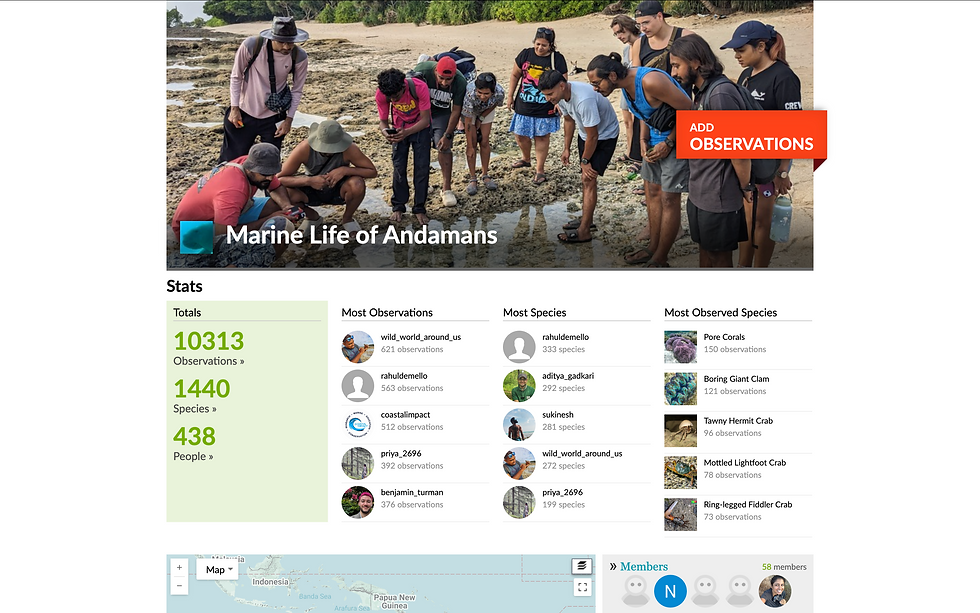
By combining marine science, citizen science and underwater exploration, we're working towards building a growing repository of open-source marine data that is freely accessible to researchers, conservation organisations, educators, ocean advocates, students and the wider public.
This data platform includes underwater species observations, 3D reef maps, fish and coral records, environmental parameters, intertidal monitoring and more.
No single research team can monitor an archipelago as vast as the Andamans alone.
Instead, we believe in building a community of trained observers - people who understand marine ecosystems, know how to recognise ecological change and can contribute meaningful observations over time.
Every survey completed, every fish identified and every reef mapped adds another missing piece to help us see the larger picture.
As climate change continues to reshape our oceans, establishing long-term ecological datasets has never been more important.

CREATING NOT JUST DIVERS, BUT EXPLORERS
Most divers get into diving so they can experience the underwater world.
We want you to experience it differently.
We want your presence to turn into purpose that leads to action.
After participating in one of our courses, a reef is no longer colourful coral and beautiful fish. It becomes a living ecosystem full of relationships, behaviours and patterns!
You begin to notice the grazing parrotfish keeping algae in check, the cleaner wrasse tending to larger fish, the subtle differences between healthy coral and a reef under stress, and the changing communities that tides shape along the shoreline.
This shift, from ‘fun’ diver to becoming a curious explorer and diving with purpose is at the heart of everything we do.
Our programmes are curated to develop observation, critical thinking and ecological understanding alongside practical dive skills.
By the end of the Samudra pathway, participants don't just leave with new knowledge. They leave with the ability to ask better questions, recognise change and become advocates for the oceans they explore.
SAMUDRA’S LEARNING PATHWAY
Whether you're a complete newbie to the ocean or already a certified diver, our courses are designed as a progressive pathway that builds your knowledge and training whilst improving dive skills.

At the end of our programs, you can become a conservation volunteer or you can choose to become a responsible fun diver and flex your knowledge to your dive buddies.
Samudra Pathway starts with…
MARINE EXPLORER
For: Anyone with a love for the ocean - no diving certification required.
Duration: 8 hours of field-based learning, including snorkelling, intertidal exploration and microscopy.
Marine Explorer introduces participants to the incredible diversity of coastal ecosystems. Through hands-on exploration, you'll discover how beaches, mangroves, seagrass meadows, rocky shores and reef flats function as interconnected ecosystems.
You'll explore topics including:
Coastal ecology
Tides and ocean processes
Intertidal biodiversity
Species adaptations
Climate change and marine ecosystems
Citizen science
You will leave our course being able to:
Read and interpret tide charts.
Identify major coastal habitats and their ecological importance.
Recognise common intertidal organisms and their adaptations.
Understand how climate change is affecting coastal ecosystems.
Participate confidently in marine citizen science activities.
What comes next?
Now as a Samudra Marine Explorer you will get an SSI x Dive India Recognition Card with lifetime validity. We will connect you to our partner organizations that conduct intertidal walks in other parts of India which you can participate in.
Fees: 15000 /-
We also offer scholarships for dive pros and local islanders.
Rolling Applications Open Now.
CONSERVATION DIVER
For: Certified Open Water Divers who want to understand the science within the ocean.
Duration: Four days
Activities:
Day 1 Intertidal exploration, Microscopy
Day 2 Snorkelling + Land demos for data collection
Day 3 Diving and Marine Behaviours
Day 4 Data Collection at Natural Bridge/ Bharatpur
Conservation Diver moves beyond marine life identification and introduces participants to the ecological and physical processes that shape our oceans.
Topics include:
Island geology
Oceanography
Ocean productivity and plankton
Tides, waves and currents
Reef ecology
Reef invertebrates
Scientific dive planning
Throughout the programme, participants begin viewing reefs through the lens of a marine scientist rather than a fun diver.
You’ll leave our course being able to:
Explain the oceanographic processes that shape reef ecosystems.
Understand how reef communities develop and function.
Identify major groups of reef invertebrates.
Apply scientific thinking to underwater observations.
Improve buoyancy and dive planning skills for conservation activities.
What comes next?
As a Samudra Conservation Diver, you will get an SSI x Dive India Recognition Card with lifetime validity. You now qualify to volunteer as a data-extractor with Ocean Monitor, Samudra's open source marine data platform where your extraction and labelling work will lead to scaling our data operations. You will work with fish and invertebrate data from intertidal regions and divesites.
Fees: 39000 /- We can include SSI Marine Ecology Speciality Course at an additional 3000 /-
We also offer scholarships for dive pros and local islanders.
Cohort-based Admissions! Apply for the upcoming cohort NOW
Blitz Diver (Coming 2027)
This is where participants can begin contributing directly to marine monitoring efforts.
This programme introduces ecological survey techniques used by marine researchers, including fish identification, habitat assessment and underwater visual census methods. Participants also learn how ecological data is collected, labelled, managed and interpreted to support science and conservation.
By the end of the course, our participants will have the skills needed to contribute reliable ecological observations to long-term monitoring projects. You become a Bioblitz volunteer and participate in surveys for various marine ecosystems - coral reefs, seagrass meadows, mangroves through which you will understand point count surveys and monitoring protocols.
Expedition Diver (Coming 2027)
The final stage of our pathway focuses on advanced conservation diving and 3D reef mapping.
Participants learn coral identification, research diving methodologies and photogrammetric 3D reef mapping. Working as part of a research team, they'll help gather data to create detailed digital models of coral reefs that can be monitored over time.
These maps allow us to document reef conditions with extraordinary detail and build a permanent visual record of our changing oceans. As an Expedition Diver, you become part of Samudra's entire volunteering ecosystem. You can participate in our Bioblitzes and 3D mapping expeditions as well as volunteer with our partner organizations in India and across the Indian Ocean.
Our reef maps are also being used as learning tools!

BUILDING A COMMUNITY OF OCEAN EXPLORERS
Whether you're taking your first dip in the ocean or looking to apply your diving skills to conservation, Our Learning Pathway offers an opportunity to become part of and contribute to something much larger than a course.
You're not just learning about the ocean.
You're helping document it, understand it and protect it for generations to come.
The ocean is changing. Help us understand how.
Applications for the Marine Explorer and Conservation Diver programmes are now open.
Come! Explore with us. Learn with us. Dive with Purpose.
Let’s build the future of marine conservation in the Andaman Islands.


Comments